How I’m using Matt Pocock’s skills inside Hermes to run sub-agents on multi-surface features
Matt Pocock’s skills repo has been getting a lot of attention lately. If you have not checked it out yet, you should. It is a workflow layer for making you and your agents think through the work before they touch code. Think in alignment first.
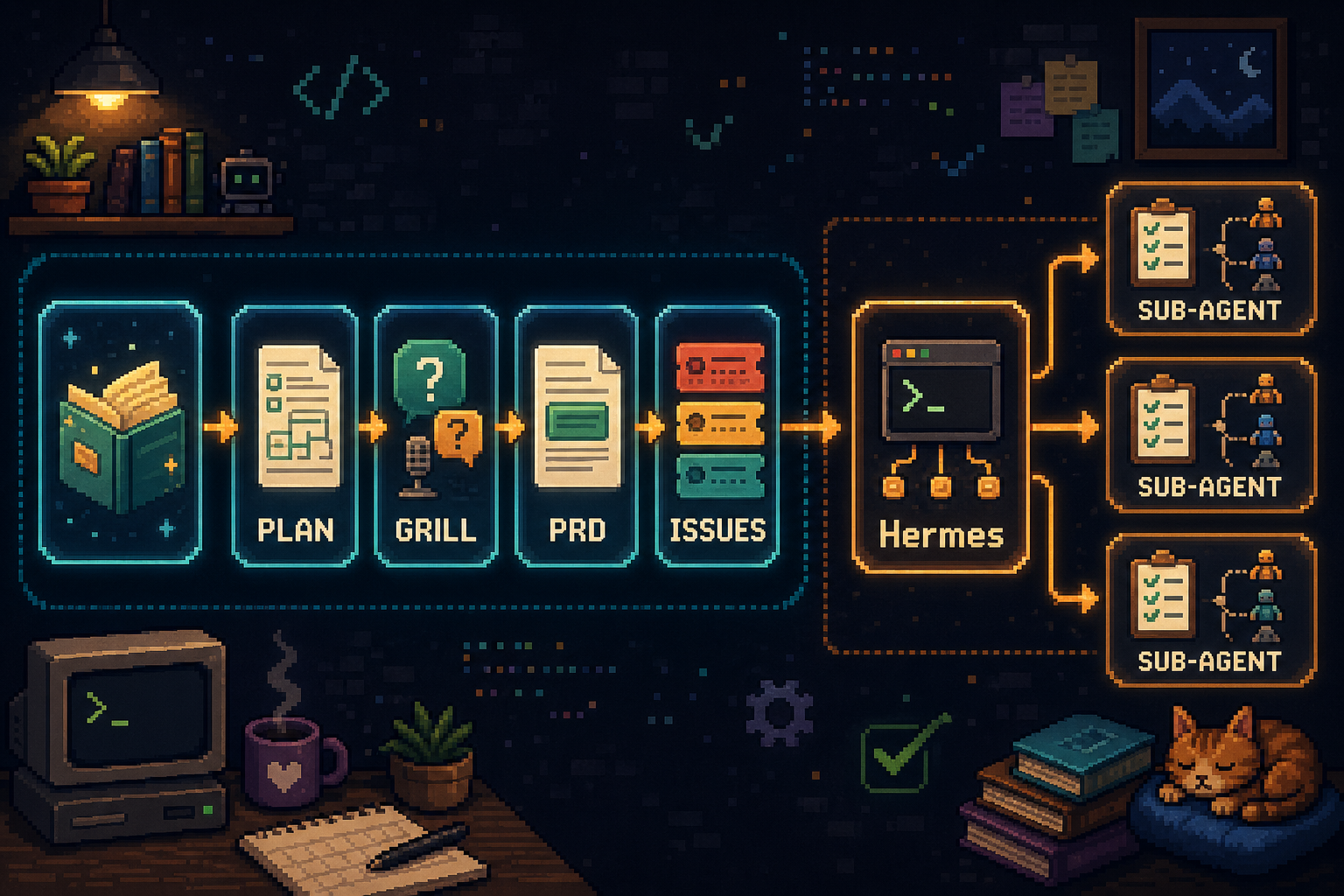
My current flow is: run Matt’s skills inside Hermes, then use Hermes sub-agents to execute the output: plan -> PRD -> issue files -> Hermes implement.
Matt’s repo is here: github.com/mattpocock/skills
He also posted his AI coding workflow in the workshop here: x.com/aiDotEngineer/status/2047704667967381811
or on YouTube: youtube.com/watch?v=-QFHIoCo-Ko
In the workshop, Matt is running the implementation with Sandcastle, his tool for orchestrating sandboxed coding agents:
github.com/mattpocock/sandcastle
But since Hermes supports sub-agents out-of-the-box, it can be perfect for the implementation.
When to use it: You already have a project, and you want to add one feature or refactor one area that touches multiple surfaces. Backend, frontend, docs, landing page, tests, maybe migrations too.
This is not a “build the whole project” workflow. I also do not think it replaces product or engineering judgment. It is a way to make a bounded feature change smoother.
TL;DR
Use Matt’s skills inside Hermes to turn a feature into executable steps, then use Hermes where Matt uses Sandcastle: run the implementation with sub-agents.
- Hermes creates a local plan.
- Matt
grill-me/grill-with-docspressure-tests the plan. - Matt
to-prdturns the plan into a PRD. - Matt
to-issuesturns the PRD into local issue files. - You check that the issues are vertical slices.
- Hermes implements those issues with sub-agents.
1. Ask Hermes for the first plan
Start in Hermes and ask it to create a markdown plan file.
Example:
1 | |
The goal is not a perfect plan. It is just the first concrete artifact.
2. Use Matt’s “grill me” skill on the plan
Then run Matt’s grill-me or grill-with-docs skill on that plan.
This is where the plan gets much better.
Ask it to interrogate the plan. Make it ask hard questions. Answer at least 8. If the questions start drifting, tell it to refocus and ask harder questions about the feature, architecture, edge cases, product intent, and what could go wrong.
The important part: it should update the same markdown plan as you answer, or at the end.
This step is annoying in a good way. It catches fuzzy thinking before the agents touch code. I got to question 50 once, then told it to wrap it up or speed it up. That also works.
3. Use Matt’s to-prd skill
Once the plan feels grounded, use Matt’s to-prd skill.
Example:
1 | |
Now you have a Matt-style PRD generated from the plan.
4. Use Matt’s to-issues skill
Then use Matt’s to-issues skill on the PRD.
Example:
1 | |
This is the point where you should check the shape of the work. The issues need to be vertical enough.
Bad issue split:
1 | |
Better issue split:
1 | |
If the split is too horizontal, ask Hermes:
1 | |
5. Run the issues through Hermes sub-agents
Now give Hermes the issue files and ask it to run them through sub-agents.
Each sub-agent should get one issue, clear allowed files, acceptance criteria, and a stop condition.
Tell Hermes:
1 | |
One config change that helped
I also hit this at first:
1 | |
This helped:
1 | |
Then restart Hermes chat.
The extra budget gave the sub-agents enough room to finish all the issues cleanly.
This still needs human judgment. You have to read the plan at least at a high level, go through the grilling session, review or reject bad slices, and catch AI slop. Running the grilling twice can help. It does find more important issues. It will not produce perfect design or text copy, but it is great at the technical parts.
Plan first. Get grilled. Turn the plan into a PRD. Turn the PRD into issues. Make the issues vertical. Then delegate.
All of that happens inside Hermes.
Hermes becomes the orchestrator. Matt’s skills create the planning pressure. The sub-agents do bounded work.
I am still early with this, but this is the first setup where multi-surface autonomous agent work did not immediately turn into a mess.